

Intel at CES 2026: Live updates from the Core Ultra Series 3 Panther Lake launch event
The new Panther Lake chips will launch during CES week.
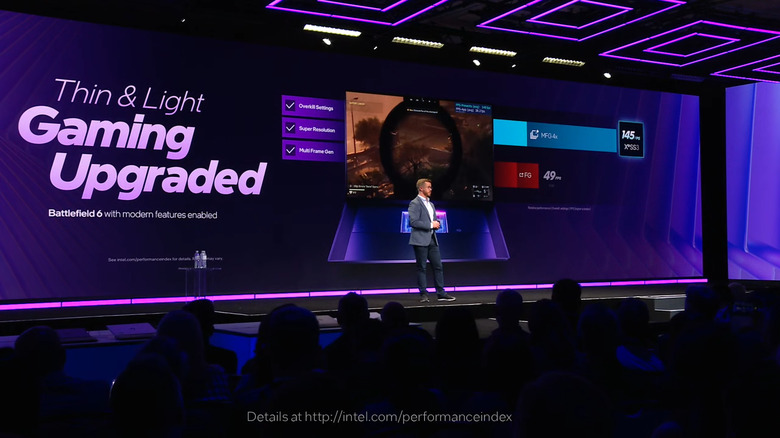
Intel's Dan Rogers talking up the Arc's big FPS numbers, and touting a partnership with EA.
CES 2026 is off and running, and chipmakers enabling the AI moment are one of the big starts of the show. In addition to NVIDIA and AMD taking the stage today, we'll also be getting Intel's 2026 launch event. The chip giant is expected to provide more details on its AI PC initiative and the new processors powering it: The Core Ultra Series 3 CPUs (aka Panther Lake) are made using an 18A process — that's 18 angstroms, or just under 2nm — and designed for high-end laptops and gaming devices.
For Intel, the stakes at CES are higher than ever. In the past 12 months, both NVIDIA and the US government acquired ownership stakes in the company, helping nearly double the stock price by the end of the year. But that's still down over more than 20 percent since 2021, as rivals like TSMC, Qualcomm, AMD and NVIDIA have taken the leadership mantle in chip fabrication and AI hardware.
How to watch Intel's CES 2026 launch event
Senior VP of Intel's Client Computing Group Jim Johnson will kick off the launch event on Monday, January 5 at 6PM ET. The livestream from Intel's YouTube channel is already available, and we've embedded it below.
Engadget will also be liveblogging the Intel presentation.
46 Updates
-
Intel hopes its Core Ultra Series 3 chips are the start of a comeback
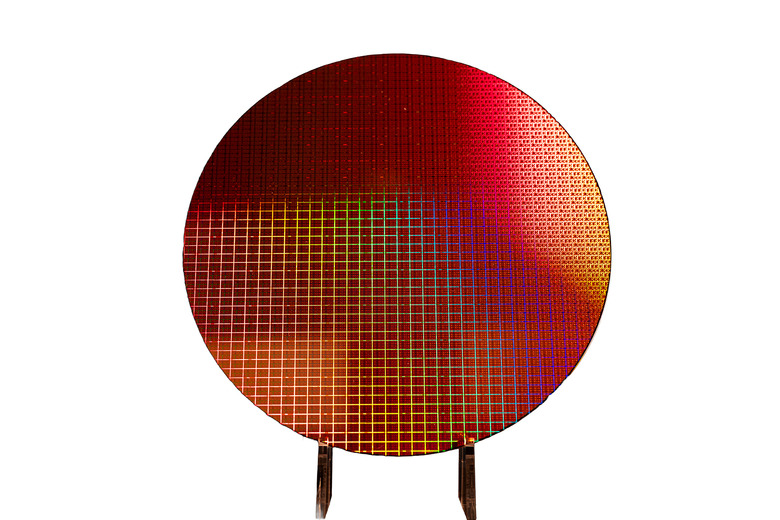
Image of a Core Ultra Series 3
Intel turned up to CES 2026 to herald the birth of the Core Ultra Series 3, a new range of chips offering "exceptional performance." It says the mobile processors, formerly known as Panther Lake, deliver great graphics and battery life alongside the aforementioned grunt. And that, for the first time, the silicon has been certified for embedded and industrial use cases, including robotics and smart cities. But, like so many stories about Intel these days, the launch is loaded with so much subtext you'll need a copy of Cliffs Notes to understand it.
On the face of it, these are just some snappy flagship chips, available in Core Ultra 7 and 9 ranges as well as Core X7 and X9, which ship with 12 Xe graphics cores over the usual four. Almost all of them offer 16 total cores and threads, and all bar two have total NPU performance of 50 PTOPS.
Read more: Intel hopes its Core Ultra Series 3 chips are the start of a comeback
-
Thanks for joining our Intel live blog. Blissfully it was shorter and more direct than the NVIDIA one that preceeded it.
-
Johnson is wrapping things up with a summary of Core Ultra Series 3, highlighting the strengths of the new architecture. Pre-orders for select products will begin tomorrow.
-
Back to Johnson to talk about Series 3 for edge customers that will deploy the chips for things like smart cities, automation and other other IoT tasks.
-
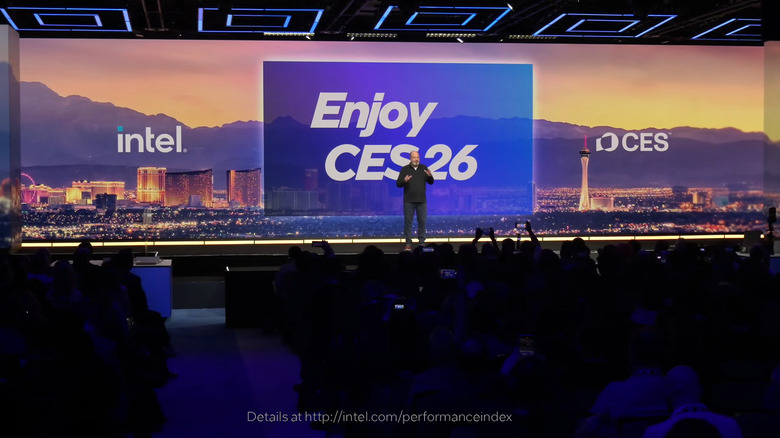
As Intel wraps up, Johnson is eager to assure the viewers that Intel has ways to make AI profitable. He may have a better case than OpenAI does right now.
-
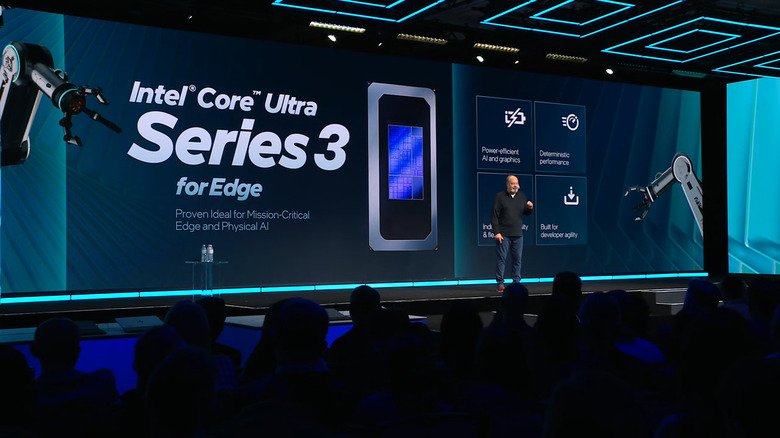
Johnson: "The demand (for physical AI) is huge, growing, and Intel 3 was designed for this task."
-
One of the reasons Srinivas says doing some AI compute locally is ideal is because it allows to run models that feel faster, with less latency.
-
Now we have the CEO of Perplexity, Aravind Srinivas, to talk about the importance of "localized compute."
-
With a limit to how quickly companies can build data centers, Johnson says he believes more AI inference work will move to the edge, which is why Intel is building chips that can do at least some of this work locally.
-
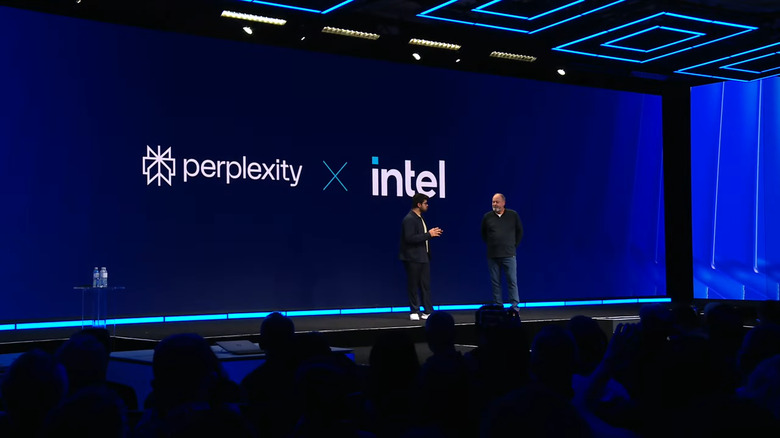
Johnson welcomes Perplexity CEO Aravind Srinivas to talk about how they plan to cut down on AI's computing delays.
-
Okay, we're back to business. Johnson says Series 3 offers up to 180 TOPS of total AI performance, with 120 TOPS coming from the GPU alone. The best Series 3 chip can handle a 70 billion parameter model locally. Johnson says none of Intel's competitors can do this.
-
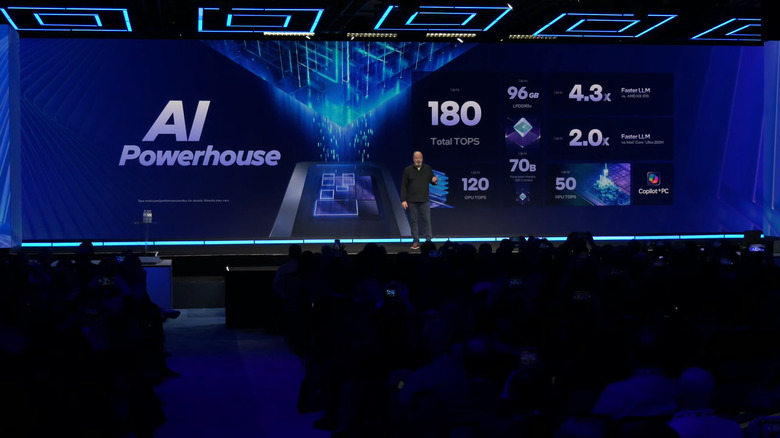
Johnson is sharing a lot of numbers, but Intel's Consumer Electronics Show presentation has so far been light on actual consumer electronics.
-
Like most things AI related, this portion of the presentation is more about vibes than specifics so far.
-
Now Johnson is back on stage to talk about AI performance and workloads.
-
Johnson changes the subject to AI, which the live chat isn't happy with. People are still awaiting news about the B770.
-
Rogers is teasing an "entire" gaming handheld platform built on Panther Lake, with more details coming later this year.
-
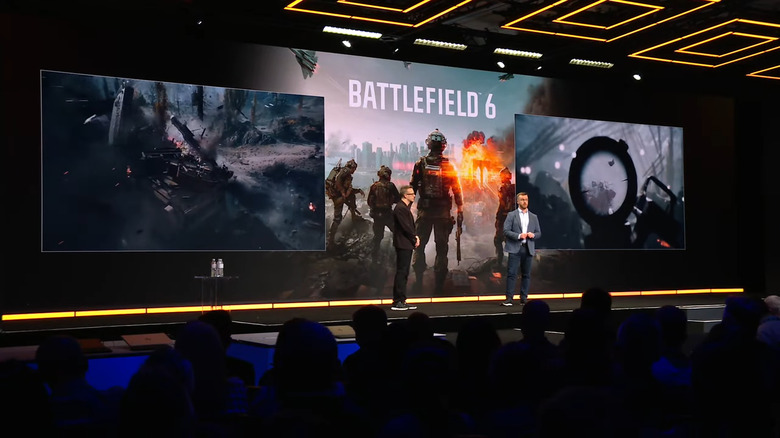
EA and Intel discuss how they wouldn't want to make a game again without AI to help enhance the graphics.
-
I'll note here any claims about multi-frame generation should be taken with a grain of salt.
-
Intel just threw up a slide showing its new integrated GPU can render Battlefield 6 on Overkill settings at 145 FPS. The catch? That's using Super Resolution and 3X multiframe generation. I'm not sure how much input lag that will introduce but it doesn't sound pretty.
-
Rogers claims B390 will deliver discrete-like GPU performance in a thin and light laptop form factor. The new component will offer multi-frame generation on day one.
-
Rogers is talking up the Arc's big FPS numbers, and touting a partnership with EA.
-
The Ultra Series 3 features Intel's new Arc B390 integrated GPU. It has 50 percent more graphics cores, twice the cache and 120 GPU TOPS of performance. In practice, Rogers says the new integrated unit should offer 77 percent faster gaming performance over the company's previous generation chip.
-
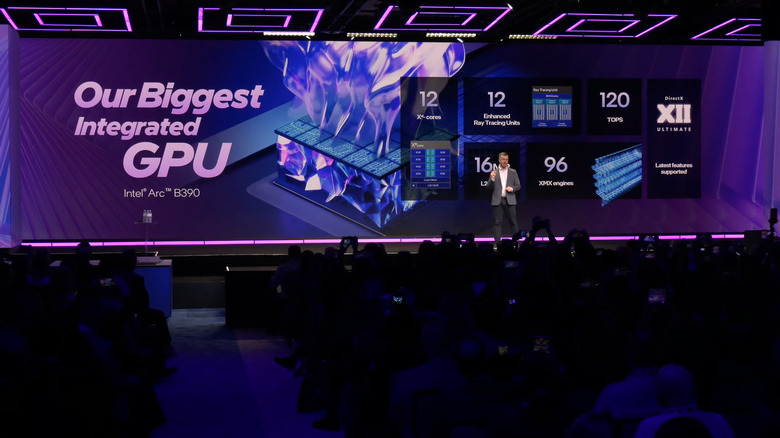
Dan Rogers, Intel's VP and GM of PC Products, talks up the prowess of the new Intel Arc B390 GPU.
-
Rogers starts by acknowledging that Intel's efforts on this front haven't always been great.
-
Now we have Dan Rogers, VP and GM of PC Products, on stage to talk about GPU performance.
-
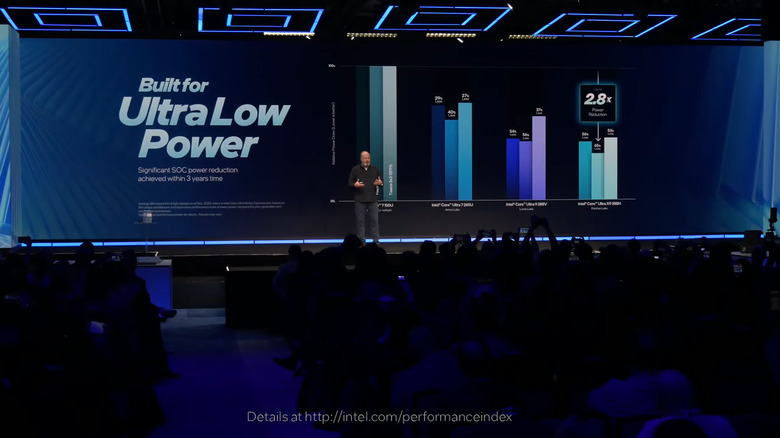
Intel is (finally) focusing on reducing power consumption.
-
According to Johnson, Core Ultra Series 3 offers up to 60 percent more performance over the company's previous generation Lunar Lake processors.
-
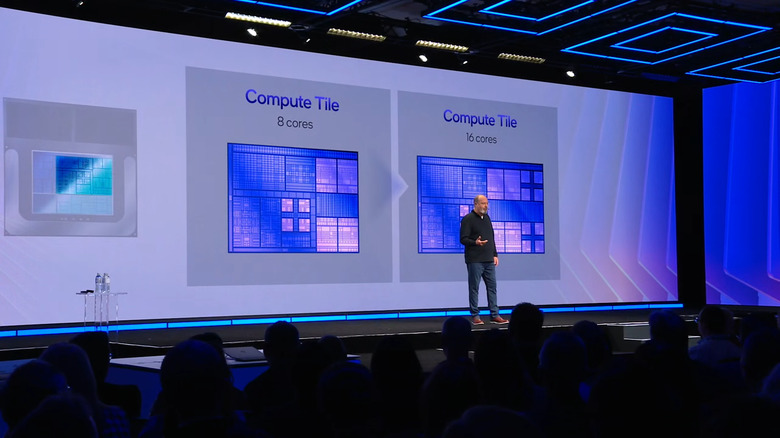
Johnson is providing details on everything from GPU to power consumption for the new SoC.
-
Broadly, Series 3 offers better performance while being more p efficient and extending battery life.
-
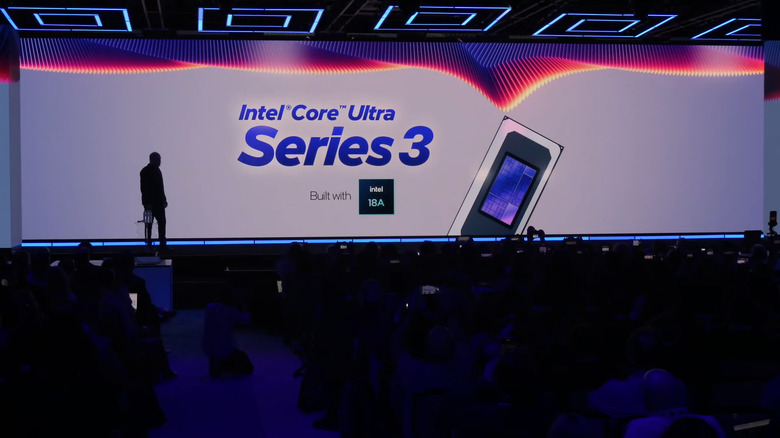
Johnson is briefing the audience on the latest and greatest Intel CPU.
-
The first processor built on Intel's 18A process is Core Ultra Series 3.
-
"With all the excitement around AI, we always remind ourselves that fundamentals still matter," says Johnson, noting people still want cool and quiet PCs.
-
"The industry and intel are both at inflection point," says Johnson. The new 18A offers 15 percent better performance per watt, according to the executive.
-
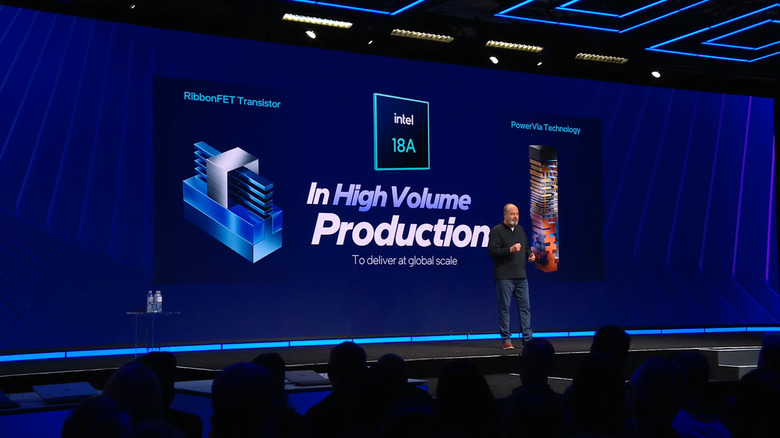
Johnson is providing an update on Intel's 18A chip production.
-
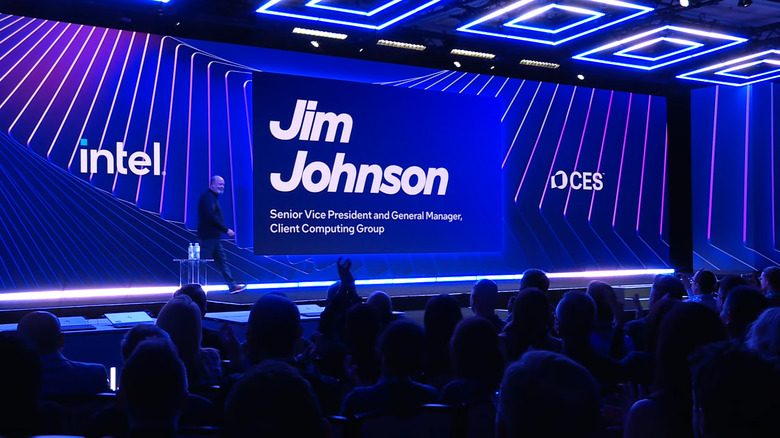
Intel SVP Jim Johnson has arrived to provide a deeper dive.
-
Jim Johnson, SVP and GM of Intel's Client Computing Group, is here to detail Panther Lake.
-
Tan begins his presentation by noting that Intel is ahead of schedule on ramping 18A production.
-
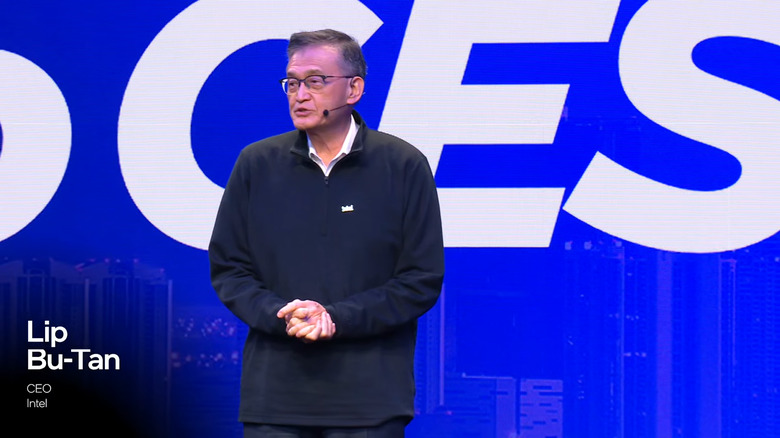
Intel's CEO Lip-Bu Tan kicks off the presentation.
-
Unlike Jensen Huang, Intel CEO Lip-Bu Tan has started his presentation right on time.
-
This is probably pie in the sky, but the company has the foundry capacity to start producing DDR memory.
-
Most of all, I'm hoping Intel has something to say about the memory crunch. I think it's an opportunity for the company to do something innovative and maybe even something that allows it to reset.
-
Igor, do you have any hopes and dreams or special wishes out of this Intel press conference?
-
As we speak, NVIDIA's CEO Jensen Huang is still going strong on the company's press conference, which started slightly late at about 1:15PM PT (4:15PM ET) and might run over. Will Intel be (even more) overshadowed by NVIDIA today?
-
As for what we can expect from Intel, I think this will be perhaps the most consequential CES in the company's history. Intel is not in a good spot financially, but the memory crunch may present an opportunity for the company to claw back the leading position it lost over the past few years.
-
Hello and welcome to our liveblog of Intel's CES 2026 keynote! We know the company will be sharing more details on its Panther Lake chips. There is likely to be stuff around AI and PCs, as well. Our AI reporter and one of our team's chip nerds Igor Bonifacic will be leading this liveblog, with support from our other chip nerds Aaron Souppouris and Devindra Hardawar. I'll be here eating potato chips.
-
Hey, Igor here. For those that don't know me, I'm Engadget's AI reporter and I'll be handling today's Intel live blog to give Devindra a chance to rest after NVIDIA's keynote concludes at 2:30PM PT.
What to expect from Intel at CES 2026
As we noted above, Intel has publicly confirmed that it will be highlighting "the next generation of Intel-powered PCs, edge solution, and the AI experiences enabled by the new Intel Core Ultra Series 3 Processors." We'll be keen to hear if the company can address the profitability concerns that have surrounded those next-gen chips since at least last summer, when published reports indicated that yields were still under 50 percent. (In response, Intel told Engadget that it felt "very good" about its trajectory on Panther Lake, though it didn't hit the late 2025 release date it had envisioned at the time.)
Will we get any updates on that NVIDIA partnership? It's possible. But don't expect to hear anything about Intel possibly fabricating the chips for that rumored new entry-level MacBook Air. If that comes to pass, the announcement will definitely be at a time and place of Apple's choosing.
Update, January 5 2026, 2:30PM ET: This story has been updated to include the embedded YouTube livestream.