

Everything announced at Apple's 'Welcome Home' event
All about the HomeView, Homepod mini, Apple Home Collection and more.
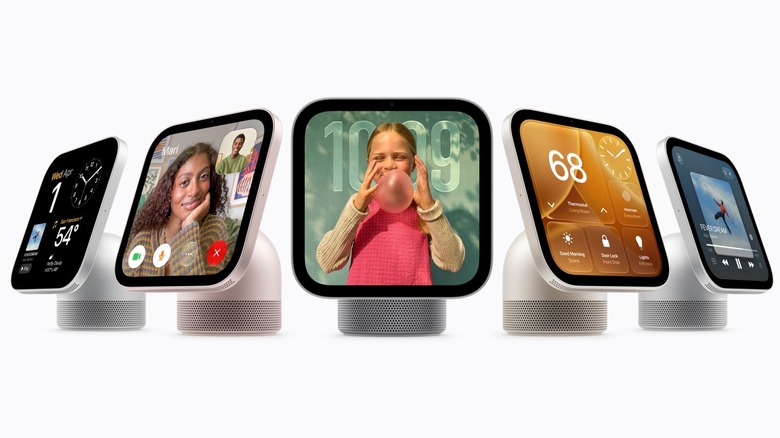
Apple is making a bigger push into the smart home domain. The company invited press and creators to a "Welcome Home" event in New York City on Tuesday to reveal a batch of fresh products, and we'll break it all down for you right here.
Among those was the long-anticipated HomeView — Apple's first smart home hub. In addition, we saw refreshed versions of the Apple TV 4K and HomePod mini. That's not all, because Apple talked up a whole ecosystem of smart home products.
Let's dive into everything Apple announced at its Welcome Home event.
HomeView smart home hub
We've heard rumors for years that Apple was working on an iPad-style display from which you'd be able to manage smart home devices. It was described as the company's answer to Amazon's Echo Show or Google's Nest Hub. Reports suggested it would be called the HomePad, but thankfully Apple steered clear of causing any confusion with the HomePod. Instead, the device is called the HomeView.
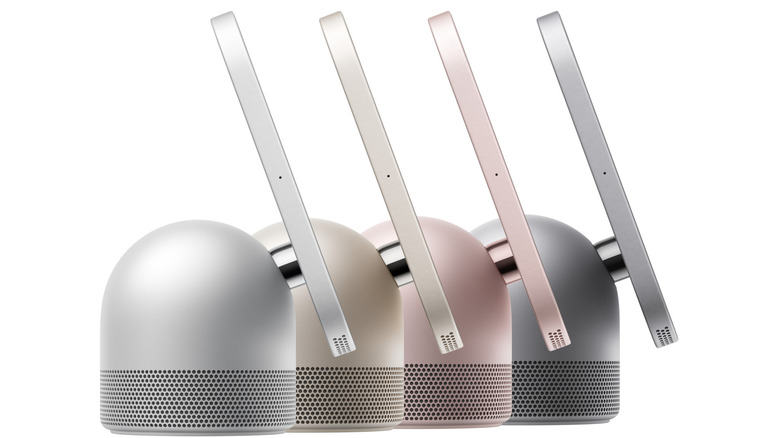
The HomeView has a tilting, seven-square-inch Liquid Retina touch display — perhaps paving the way for the touchscreen MacBook that's said to be coming very soon — that's attached to a base with a speaker. There are two variants. You can place one on a table or countertop and mount the other to a wall.
The display itself has two full-range drivers, which complement the down-firing woofer and two force-canceling passive radiators in the base of the countertop model. The wall-mounted version doesn't have a base, but Apple says its audio is tuned for wall placement. The screen has a maximum brightness of 500 nits and that can drop down to 0.3 nits (useful if you're using HomeView on a nightstand next to your dozing partner).
The device is powered by Apple Intelligence and has Siri AI baked in. (Reports suggested that Apple had put HomeView on ice until the delayed Siri AI was ready.) You can start a conversation with the assistant on HomeView, and continue on another Apple device. You'll also be able to handoff things like music and recipes from your iPhone to HomeView as well.
HomeView can recognize the face of the person who's interacting with it (up to six people), and automatically switch from a shared household screen to a customized interface for that individual. This should mean the user will have access to their own notifications and calendar, as it can tap into their personal data from their iPhone or iPad. You'll be able to have Apple Watch-style custom "faces" on HomeView that have four adjustable widgets and can feature things like weather details, some favorite photos and Snoopy animations.
Among other things, HomeView supports FaceTime calls thanks to a 12MP front-facing camera. Entertainment options include music, podcasts and video streaming, and Apple says you can follow recipes while you're cooking.
Apple says it designed HomeView to keep users' information secure and separate. The company stressed that it doesn't track or sell your data to others.
The HomeView runs on the A18 chipset, the same one that powers the iPhone 16, iPhone 16 Pro, iPhone 16e and MacBook Neo. It costs a surprisingly reasonable $299 for both the tabletop and wall-mountable versions. The countertop version comes in four relatively muted color options: silver, starlight, rose pink and space gray. The wall-mounted model is available in space gray and silver. Pre-orders open today and it'll ship on November 13.
HomeView is initially available in English in the US, Australia, Canada, India, New Zealand, Singapore, South Africa and the UK. Apple says it'll add Canadian French support later via an update.
Be sure to check out our hands-on for our initial impressions of the HomeView.
Apple TV 4K (2026)
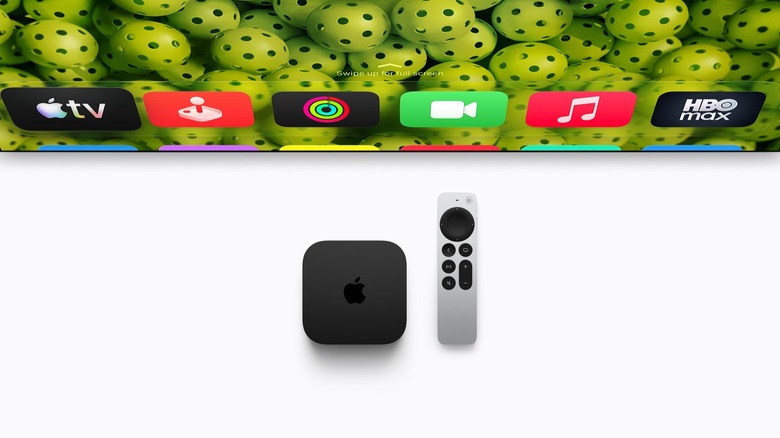
The newly refreshed Apple TV 4K runs on the A19 chipset, the same one the company used in the iPhone 17 and iPhone 17e. Since Siri AI can pull from personal context on your iPhone, you can ask the assistant to do something like "play that show my sister texted me about" and the Apple TV 4K should fire it up. The assistant may offer suggestions to refine your searches and it can display responses to your questions on screen. Of course, you can control smart home devices using Apple TV 4K as well.
The set-top box has far-field microphones that'll let you talk to Siri AI hands-free. It can pair with up to four HomePod mini 2 speakers for surround sound. You won't have to bother tuning them manually, as the system will automatically calibrate the speakers for your space.
If you misplace the updated Siri Remote (or a family member has), you can use a voice command to trigger an audio alert to help you locate it. It has Find My support with Precision Finding as well.
Pre-orders for the latest Apple TV 4K open today and it costs $299 ($100 more than the previous model even after a price hike earlier this year). It'll ship on November 13.
Apple says Siri AI is available in beta on the last two versions of the Apple TV 4K as well (as in the models it released in 2021 and 2022). Folks in the US, Australia, Canada, India, New Zealand, Singapore, South Africa and the UK can use the assistant on their set-top box in English.
The fourth-gen Siri Remote will also available to buy separately. It works with Apple TV HD and Apple TV 4K, just in case you happen to lose the thing a bit too often and want it to play a sound so you can track it down.
HomePod mini 2
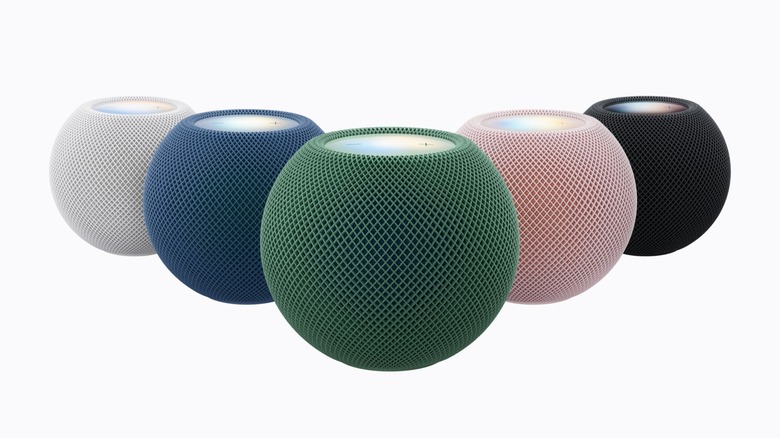
Rather than an A-series chip, Apple opted to slot the S10 into the HomePod mini 2. That's the same chipset that the Apple Watch Series 10, Series 11, SE 3 and Watch Ultra 3 run on, and it means you can use Siri AI with the speaker. Apple says that, along with answering questions that spring to your mind, Siri AI can help you get things done, such as adding items to a family calendar.
However, Apple notes that the latest version of the voice assistant won't be available on the HomePod mini 2 right away. The company will add Siri AI to the device with "a future software update."
The speaker is available in new colors — pink, blue and green to match iMac — as well as white and midnight. The lights on top of the HomePod mini 2 can match the album art of whatever song you're playing at that moment and pulse in time with the beat. Apple calls this feature Sound Glow. What's more, you can use the HomePod mini 2 as a default speaker for your iMac (or two of them for proper stereo sound).
The HomePod mini 2 costs $149. As with the new Apple TV, pre-orders open today. You'll be able to set it up in your home (at least if you're in a region where the original HomePod mini is currently available) starting on October 30.
Apple Home Collection
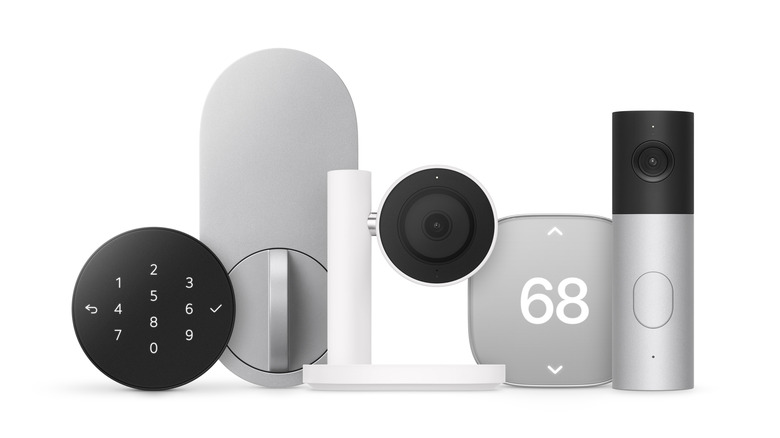
Apple has supported an ecosystem of smart home devices for well over a decade through the HomeKit framework, and now it's expanding on that. The company is working with LG and Schneider on devices that fall under an umbrella called Apple Home Collection. The initiative speaks to Apple stamping its own branding more prominently on smart home devices.
The lineup includes indoor and outdoor cameras, a video doorbell, smart door lock, thermostats and temperature sensors. Some will be available in December and others will begin to arrive early next year.
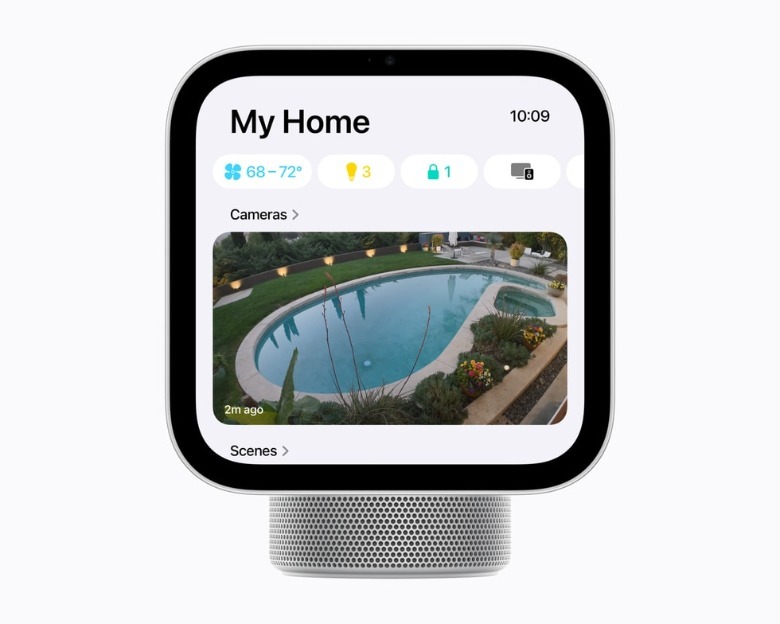
They can all be set up with a tap and managed through the Home app on an iPhone. You'll be able to manage them using Siri and devices like HomeView as well, of course. You'll be able to set up scenes for your smart home devices that can, for instance, change the thermostat, tilt an indoor camera down as you're getting dressed and play music.
All of products support Thread, so they should remain connected if your Wi-Fi network conks out. The devices will also automatically connect to your new Wi-Fi network if, for instance, you change routers or move home.
Data is encrypted, meaning neither Apple, LG nor Schneider can access it. Apple says you'll need to be running the latest version of iOS to use NFC pairing. It adds that some features require a hub like the Apple HomeView, Apple TV or a HomePod.
 Apple
Apple
LG's cameras support up to 2.5K video capture and can recognize people, familiar faces, pets, vehicles and packages. Video is stored using iCloud, so you won't need a separate subscription. Event video history is saved for up to 10 days. On certain iCloud+ plans, Apple Intelligence can generate video descriptions and allow you to search clips using natural language. The cameras have built-in storage too.
The $250 Video Doorbell Wired has two cameras and a built-in spotlight. You can switch between the top view (which offers 2.5K resolution) and the full HD camera on the bottom. Its chime can play over HomeView, HomePod and HomePod mini.
LG's $400 Floodlight Cam has dual adaptive floodlights that switch on when the device detects motion and low-light color night vision. The Outdoor Cam ($300) supports low-light color night vision as well. As for the $200 Indoor Cam, that can automatically tilt up and down when you access the camera remotely and tilt back down when someone comes home. You can tilt the camera as you wish via the Home app too.
The $350 Smart Deadbolt Lock can connect to the Ultra Wideband chip on your iPhone or Apple Watch, so it can unlock automatically as you approach the door. If you'd rather tap your iPhone or Apple Watch, use a PIN or unlock the door with an actual key, you can do that too. You can also open the door via the Home app. If you have the doorbell and smart lock, you can speak to a visitor who buzzes you and unlock the door for them if you wish. If your Wi-Fi network goes down, the lock will still work locally thanks to Matter and Aliro compatibility.
LG and Schneider will each offer smart thermostats ($200 each) that can automatically adjust the temperature depending on whether someone's home, getting ready for bed or out somewhere. They can tap into sensors from LG and Schneider that monitor temperature and humidity ($40 each) and as well as those built into HomeView, HomePod and HomePod mini. These thermostats and dedicated sensors are Matter compatible and work with several HVAC systems, Apple says.