

NVIDIA's DLSS 5 launches with NBA 2K27 on September 3, but there's little reason for excitement
Ultimately, DLSS 5 doesn't seem very essential.
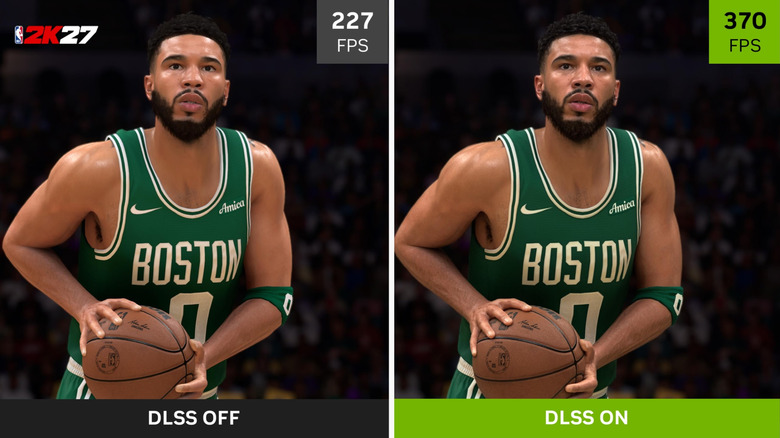
It's hard to recall a feature that's been as instantly reviled as NVIDIA's DLSS 5, a new version of its AI upscaling technology that can modify character models and environments to chase the specter of "photorealism." NVIDIA calls it progress, but the initial examples from Resident Evil: Requiem and Starfield were uncanny misfires. Now, NVIDIA is gearing up to finally launch DLSS 5 alongside NBA 2K27 on September 3. And judging from the wildly negative responses to recent leaks of the technology, it's going to face a tough crowd.
I had serious doubts about DLSS 5 at first, but after seeing some remote demonstrations of the tech from Gamescom, my hackles have cooled a bit. Sure, it's an AI tool that could be used to obscenely yassify a fragile character suffering from PTSD, like it did for Resident Evil: Requiem's co-lead Grace. But dialed in more carefully, it could add layers of realistic shadows and texture depth that would be expensive to generate through raw GPU power alone, as I saw in NBA 2K7. Will more developers take the subtle approach? God, I hope so.
The big problem with DLSS 5 is that NVIDIA is treating it as a major milestone for gaming. In actuality, it's even less essential than real-time ray tracing, another resource-hog of a feature that NVIDIA initially hyped up for its RTX 20-series cards. No doubt, ray-traced lighting and reflections can be genuinely impressive, but even the fastest consoles today have trouble delivering high-end ray tracing features at 60fps. You'll also need to flip on DLSS, AMD's FSR or other upscaling technologies to crank up ray tracing features on most video cards.
The true holy grail of ray tracing features, path tracing, can only be enjoyed by lucky gamers with tremendously powerful rigs. Similarly, DLSS 5 only works with NVIDIA's RTX 50-series GPUs — everyone else is simply out of luck. Even if you have access to it, the best DLSS 5 demos I saw were supremely subtle. It added a bit more depth to a bazaar merchant's face, and it made NBA stars seem a bit more lifelike in NBA 2K27. None of the demos were as potentially groundbreaking as NVIDIA's first ray tracing showcases (which most games never lived up to).
To put it simply, DLSS 5 seems like it's mainly meant for pixel-peeping sickos. Most gamers won't miss it one bit."When we look ahead at our ultimate goal of achieving Hollywood-grade photorealism or just the real world, we're still looking at a chasm," NVIDIA's Edward Liu, Director of Applied Deep Learning Research, said in a media briefing. "Compared to where we started, our compute budget has increased from over 400,000 times more compute than we did before. But we're still really orders and orders of magnitude away from really simulating the real world in real time. And part of the reason is that traditional computer graphics generate images from physically-based first principles."
According to Liu, DLSS 5's AI rendering helps to jump the gap between the desire for photorealism and traditional graphics rendering. Essentially, that's been the job of DLSS's neural upscaling all along. Early models helped bridge the gap to 4K gaming, then the addition of frame generation made up for framerates you lost when flipping on ray tracing features. Now, DLSS 5 can simply add another layer of polish on top of whatever you're playing.
 RenoDX/YouTube
I've always thought of ray tracing as something nice to have, but also something that has never been essential to what makes a game great. It adds some great environmental detail to an older game like Control, but the core of what makes that game great is Remedy's incredibly gameplay and storytelling. DLSS 5 won't change that one bit, and in the cases of leaked demos we've seen from Control, it can also actively hurt the aesthetic of the game. (In fairness, the final version of DLSS 5 may not be as nightmarish.)
At the very least, DLSS 5 doesn't have the same issues as other generative AI tools, which deliver uncertain probabilistic results. According to Liu, by using the game's render frame, which is "a lot more information dense and constrained compared to something like a text prompt," DLSS 5 can generate deterministic outputs. "A fruit will stay a fruit," he said. "The same character will still be the same character." Liu also notes that higher quality inputs, like a higher resolution game with ray tracing enabled, will deliver better overall DLSS 5 results.
There's also the potential for technology to push beyond what artists actually intended, which remains a concern. NVIDIA's Gabriele Leon, Director of Real-Time Content Technology, views it another way: "DLSS 5 is a tool for developers and for artists [...] to bring their vision closer to what they might have intended," he said in the media briefing. One of the folks behind NBA 2K27 seemed genuinely enthusiastic about the technology, as it seemed to add another layer of realism to both player models and crowd NPCs. But as an NVIDIA partner, what else would he say?
At this point, the best thing I can say about DLSS 5 is that it seems relatively harmless. NVIDIA has tried to roll out obscene AI features before, like its nightmarish AI NPCs, but they've lacked widespread developer adoption. If DLSS 5 becomes a tool for overcranking character models beyond recognition, I could see developers ignoring it entirely. And for gamers, that won't be a huge loss.