

Sony Bravia Theater Trio review: The three-piece soundbar alternative
It’s a decent option for huge TVs, but you’ll still need to add on to this already expensive set.
- Three-piece design works well for large TVs
- Excellent clarity and detail for TV and movies
- Easy to use for music
- Expensive
- Side speakers are large
- 3.0.2-channel setup limits immersion
- Needs a subwoofer
We may receive a commission on purchases made from links.
Super-sized TVs demand a few special considerations. There's the obvious one: You need to make sure you have enough room for it. Then there are the more subtle choices to mull over, like how to boost the TV's audio without using a soundbar that might look hilariously small in front of an 85-inch display. Even though flagship soundbars can be over 50 inches wide, they start to look small compared to today's ultra-large TVs. Plus, you may lose any immersive, enveloping effects since it might sound like the audio is only coming from the center of the screen.
Sony thinks it addressed this problem with its new three-piece soundbar. The Bravia Theater Trio features a smaller soundbar-like speaker in the center for dialogue with two larger vertical speakers on the side to assist with directional sounds. You still get several handy features from Sony's more traditional soundbars, but the price of this trifecta ($2,200) may deter would-be buyers who've likely already spent big on a massive TV.
Design
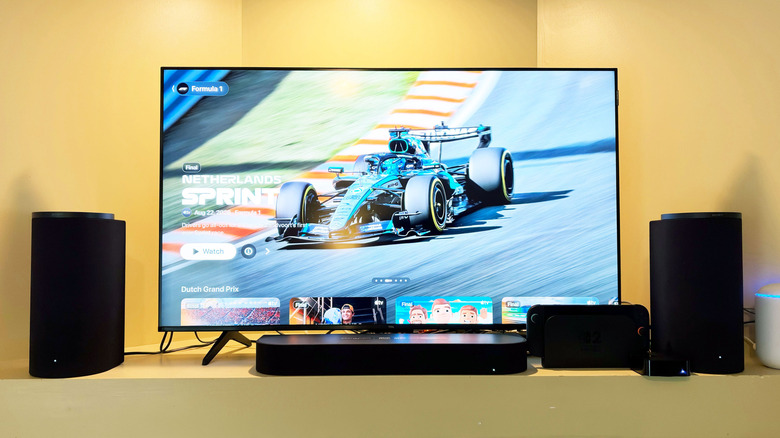
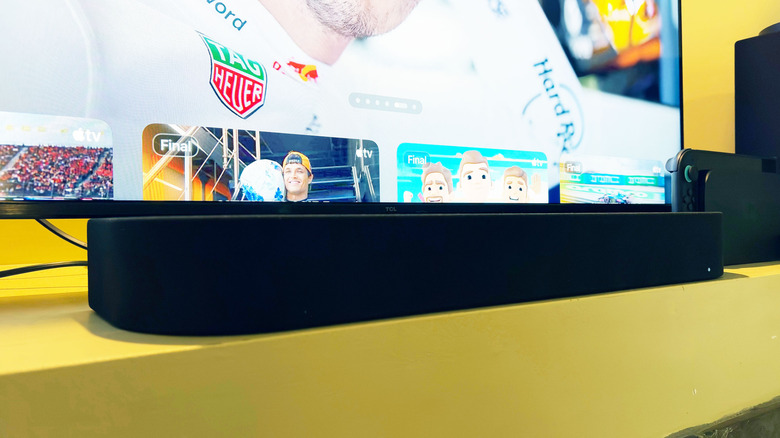
In the middle of the Bravia Theater Trio is a center speaker that looks a lot like a compact soundbar. This unit has two woofers and a tweeter inside. Sony says it opted for larger drivers here for enhanced clarity, especially when it comes to dialogue. The two side speakers contain one woofer and one tweeter that face the front, with an additional angled up-firing driver at the top.
The major consideration with the Trio is the size of the two side speakers. At just over 13 inches tall, they're easily the biggest speakers I've tested beside my TV. I only have a 50-inch TCL set in my living room, so I'm well aware I'm not Sony's target audience here. However, despite the imposing stature, the side speakers don't look out of place flanking my smaller TV. Of course, they'll look considerably more proportional if placed on a shelf below, or mounted beside, a screen that's 85 inches or larger.
Once you find the ideal location for those side speakers, you don't have to worry about running a wire to the center unit. The Theater Trio devices connect to each other wirelessly, so you only need to hook up the power cord for the two side speakers. And for the center speaker, there's only a power cable and the HDMI cord to your TV to worry about. Unless, of course, you have to use that HDMI input for a gaming console or streaming box.
Another notable design element is actually an omission. There are no buttons on any of the Theater Trio speakers. Instead, you can use either the included remote or the Bravia Connect app to make changes. This wasn't a huge deal for me as I can use my Apple TV remote for volume control. For any other settings, I don't mind diving into the app. However, there were a few times where I was standing next to the center speaker and would've loved to adjust the volume or swap the input without reaching for a phone or remote.
Setup and features
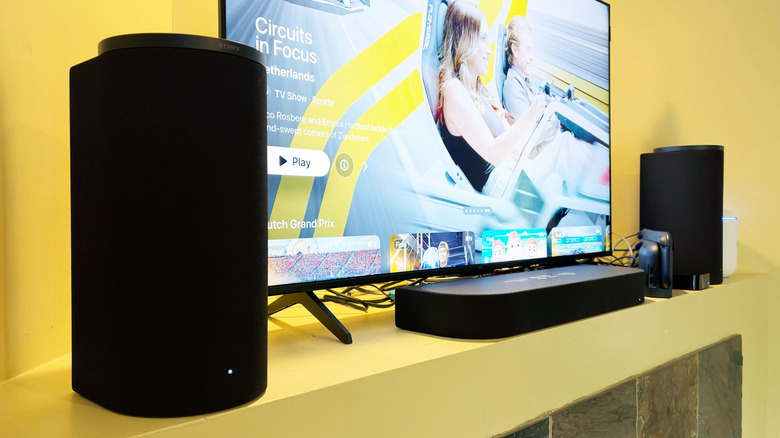
The Bravia Connect app is where you'll conduct the initial setup and access the Theater Trio's features. I had some trouble running the connection process the first few times I tried, but after restarting the system and my phone (and waiting a day for my rage to subside), I was able to complete the room calibration. I'll note this wasn't a major problem because the Theater Trio will work as soon as you connect your TV via the HDMI eARC port and plug all of the speakers into outlets. All three speakers automatically recognize each other quickly after you turn them on. I just wasn't able to fine-tune the system to my living room for the first 24 hours or so.
The best of Sony's audio and home entertainment tools are on display with the Theater Trio. You get 360 Spatial Sound Mapping, which simulates both direct and reflected sound from a collection of phantom (virtual) speakers. There's also Sound Field Optimization, or Sony's take on room calibration, which uses a USB-C microphone plugged into a phone or tablet to measure frequency, phase and delay more accurately (the mic comes in the box). Voice Zoom 3 leverages AI to recognize human voices in movies and shows to amplify their volume while DSEE Ultimate upscaling recovers detail in music that's typically lost to digital compression.
Speaking of music, the Trio has a Multi Stereo mode that plays the same sound from all speakers instead of splitting it into various channels. This is great for parties and entertaining with background tunes, especially after you add rear speakers to the mix. I'll also point out that this system has an upmixing tool that translates stereo content into 3D audio. An algorithm can extract and reposition various sounds and, during the process, AI Sound Separation maintains the clarity for voices. In terms of wireless connectivity for music and podcasts, the Trio supports Bluetooth in addition to both Spotify Connect and AirPlay over Wi-Fi.
The Bravia Theater Trio also has a robust array of wired input options. That HDMI 2.1 input supports 4K/120 passthrough (and up to 8K HDR), which will be welcome news for gamers. What's more, Dolby Atmos and DTS:X are supported, along with both wired and wireless Hi-Res Audio.
Sound quality
If you were hoping for a bunch of audio channels spread across these three speakers, get ready to be let down, as that's not how Sony configured them. Despite only being a 3.0.2-channel system, which is quite limited by today's soundbar standards, the Theater Trio does an admirable job with 5.1 and 7.1 content. If you're looking to really blanket your living room in immersive directional audio, you'll want to add either the Rear 9 or Rear 8 speakers to this collection. And for booming bass, you'll need to tack on a wireless subwoofer; Sony offers three options of those in varying sizes and strengths.
As a more-than-capable TV sound boost, the Theater Trio does very well. Dialogue is primarily kept in the center speaker while the two side units handle the rest. This physical location spread offers a sense of movement when needed, especially during fight scenes in Marvel movies or grand prix clips in an episode of Drive to Survive on Netflix. All of the claims Sony makes here about audio clarity hold up, and there's more than enough detail to keep you locked in to whatever's on screen.
The Bravia Theater Trio has a warm sound profile for music, and that crisp clarity allows acoustic instruments to really shine. Across various albums from Punch Brothers, Tyler Childers and Billy Strings, all of the guitars, mandolins, banjos and bass seemed to float through the mix. And Billy Strings' live album seemed to wrap my living room with crowd noise for a fleeting sense of being at the shows. Multi Stereo mode also meant that there wasn't any weird instrument separation across the speakers, which could impact performance if the vocals are only in the center and not spread to the side units.
Those softer musical styles sound good — even great at times — but for most bass-heavy genres, the Trio just doesn't offer enough low-end tone. Bayside's "Already Gone" lacks the energy that would normally be brought by the driving beat and thumping kick drum. And it was a similar story with synth-laden electronic tunes, like Nine Inch Noize. For some genres, the Theater Trio will be adequate, but you'll eventually find a track that puts demands on this unit that it simply can't fulfill.
The only issue I encountered during my month testing the Bravia Theater Trio, after my initial setup speed bump, was thankfully something that was resolved quickly. While streaming TV shows from Disney+ on an Apple TV unit, the center speaker randomly cut out , leaving only audio from the two side speakers. I still had dialogue, but the overall sound quality was obviously degraded. After power cycling the set of speakers and restarting both my TV and Apple TV, audio was restored to all three members of the Trio. I'll also note this has only happened once.
The competition
If you're looking for a soundbar equivalent that's broken up into multiple pieces like the Theater Trio, you don't have many options. Sony's own Bravia Theater Quad is one alternative — a system that's four separate home theater speakers with a hub for connectivity. This collection is meant to be positioned with two speakers near your TV and two behind you, so you get a more traditional surround sound effect. Each of the four speakers houses a woofer, a tweeter and both full-range and up-firing drivers (one of each) for 16 total drivers in the system. However, you'll likely need a wireless subwoofer for the Quad, which will cost you extra on top of the $2,700 it already costs.
For a non-Sony option that's powerful enough to match up with larger TVs, LG's Sound Suite fits the bill. Not only can you mix and match between a soundbar, speakers and subwoofer, but you can also opt for a full set of all of that — with up to four speakers. If you're concerned LG's H7 soundbar will look silly in front of your 98-inch TV, you can skip it and use four M7 speakers and a subwoofer instead. Plus, the Sound Suite utilizes Dolby Atmos FlexConnect that allows you to position the devices anywhere you need them; they don't have to be at equal distances from the TV to sound good. The downside? The maxed-out Sound Suite configuration will cost you $3,200.
Wrap-up
I have to commend Sony for trying new things with its home theater gear. The Bravia Theater Quad was a unique take on living room sound, and so is the Theater Trio. While the Quad is more successful in delivering on its premise, I can also appreciate that the Trio gives big-screen owners another option that's not a soundbar. There's plenty to like here in terms of features, but you'll definitely need more speakers and a subwoofer to feel like you have a truly immersive setup. And when this set already costs over $2,000, the immediate need for more gear makes the Trio a tough sell.