

The only GameCube that could play CDs and DVDs is rarely found below $1,000 today
This is one strange console.
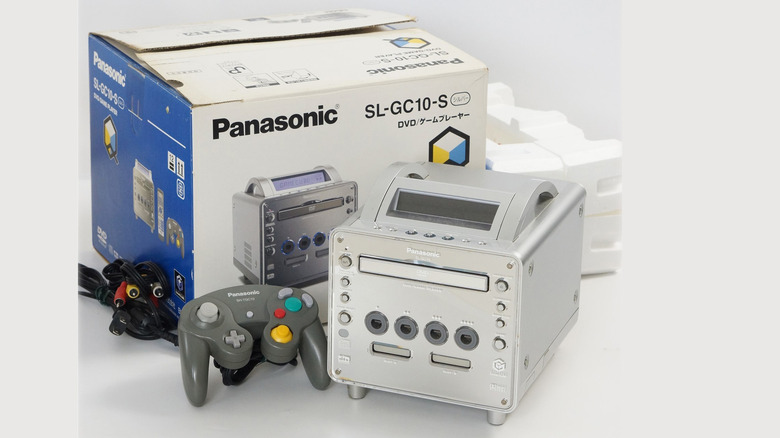
One reason GameCube games hold their value so well today is that, compared to other Nintendo consoles, it wasn't exactly a hot seller. Why was that? Well, it's partly because the PS2 had what the GameCube didn't: a built-in DVD player. Out of that market pressure was born the Panasonic Q. While this oddball GameCube/DVD player hybrid barely got off the ground, its scarcity has led to a second life as a niche collector's item.
The Japan-only Panasonic SL-GC 10, widely known as the Panasonic Q, arrived in December 2001, three months after the Nintendo GameCube debuted in Japan. Looking less like a Nintendo console and more like a home-theater appliance, the Q had a reflective front panel, a backlit LCD and ports with a blue glow. If you want quintessential 2001 consumer electronics design, look no further.
The oddball pairing of Panasonic branding with Nintendo gaming stemmed from an existing relationship between the two companies. It turns out Panasonic's then-parent company, Matsushita (which is essentially Panasonic today), helped design the GameCube's optical miniDVD format. It seems likely Nintendo saw the gaping DVD hole in its console strategy and decided to roll the dice.
A GameCube for the DVD era
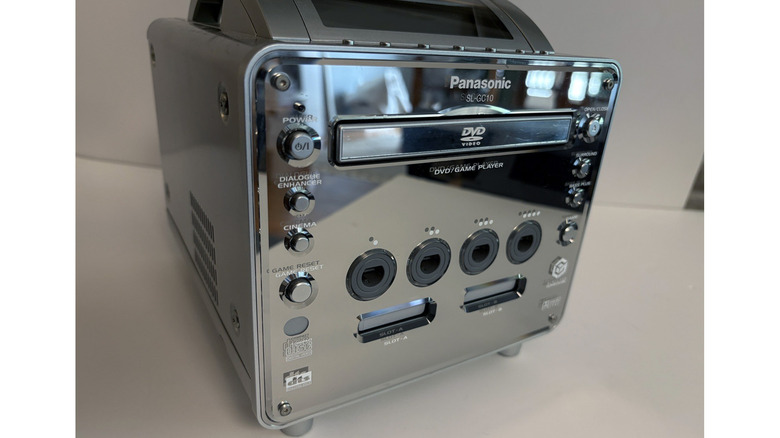
The Panasonic Q was a bizarre mashup. Its motorized disc tray accepted GameCube discs, DVDs and audio CDs. The company took the home theater part seriously. The Q had a Cinema mode for picture processing, along with audio features like Dolby Digital, DTS (Digital Theater Systems) for surround sound, Dialogue Enhancer and Bass Plus.
Those home theater features sure must have been nice for games like Super Mario Sunshine or Metroid Prime, right? Unfortunately, no. That's because the Q's home theater features were split off from the game console. Game audio was limited to the GameCube's standard analog connections. There was even a hardware button to manually switch between the two modes because it wouldn't change automatically based on the disc type. When it was time to switch, the system effectively powered down one side and restarted the other.
The Q also came with Panasonic-branded accessories reflecting the product's duality. There's a gray GameCube controller with Panasonic branding for games and a matching gray remote control for the DVD player. This wasn't so much a hybrid device as it was two distinct machines from two companies sharing the same chassis. Oh, early oughts, how we miss you.
Setting aside the exterior, the gaming half of the Q was no different from a standard GameCube. You could pop in Super Smash Bros. Melee or Mario Kart: Double Dash!! and have an identical experience to your friend with the regular version. It had the same controller ports, memory card slots and full compatibility with the GameCube library (although unmodified models were region-locked to Japan).
The weird industrial design did lead to one tradeoff: the GameCube's Game Boy Player didn't fit. The optional accessory, which let you play Game Boy, Game Boy Color and Game Boy Advance games, lodged underneath Nintendo's system. But because the Q's base was different, Panasonic had to release a modified version of the Game Boy Player designed for its shiny, weird console.
Despite all of that effort, the Panasonic Q struggled to find an audience — mostly because it was damn expensive. It launched in Japan at ¥39,800 (roughly $313 at the time) — a lot of money for such an oddball product. Although that matches the PS2's Japanese launch price, Sony's console arrived nearly two years earlier, had already built a huge audience and made the DVD player a central selling point. Not to mention, you didn't have to reboot your console to switch between the two modes. Plenty of modded imported units made it overseas, but the Q never launched outside of Japan.
A rare piece of gaming history
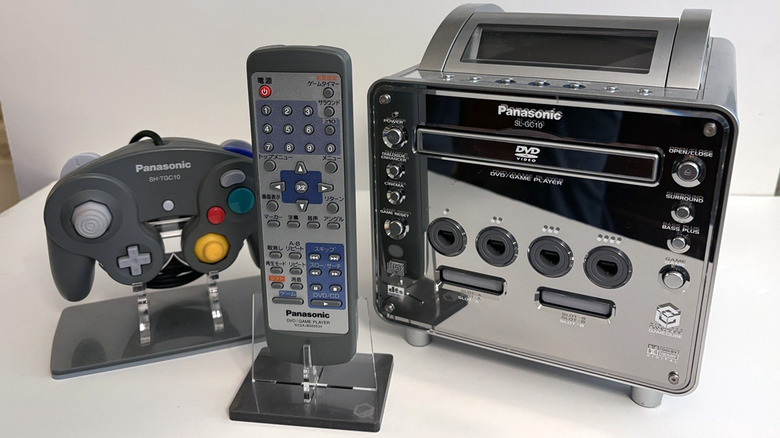
And that brings us back to its collectible status today. Because of all that, there just aren't that many Panasonic Qs in the wild today. So when they do turn up on places like eBay, they can fetch a pretty penny. Loose consoles generally sell in the $1,200 to $1,300 range. Models with the original packaging and paperwork can surpass $2,000. It wasn't a legendary product, but for those who held on to one, it ended up being a good investment.
It's only fitting that one of the weirdest game consoles ever made also has one of the strangest stories: being more successful as a 2020s collector's item than it ever was as a consumer product.