

Lenovo Yoga Slim 7i Ultra Aura Edition review: A capable ultralight laptop that's way too expensive
There’s a lot to like here, but the current price is a bit too steep.
- Incredibly light
- Gorgeous OLED screen
- Excellent keyboard
- So expensive
- Not enough ports
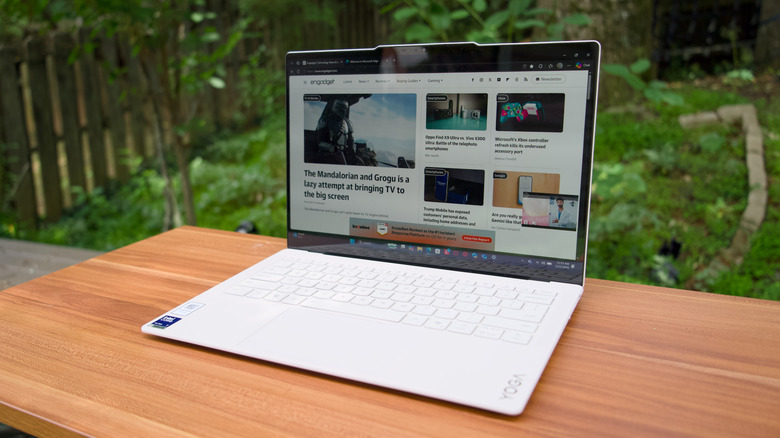
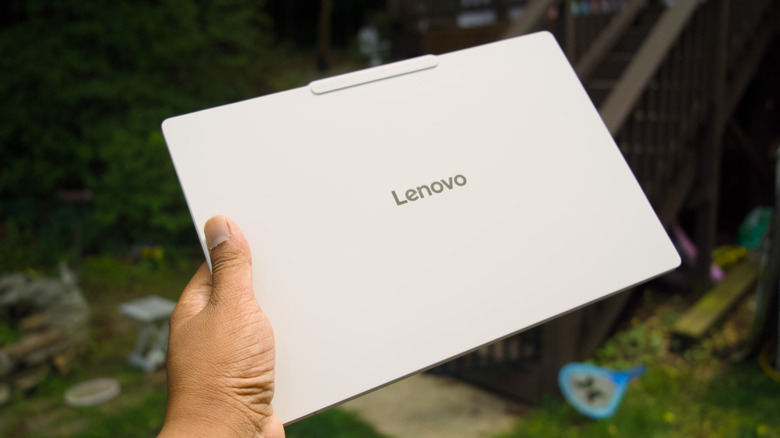
It's been a while since I've been truly intrigued by a Lenovo laptop. The ThinkPad lineup has been steadily reliable for years, but I've also been wary of the brand's sometimes shoddy build quality. However, the Yoga Slim 7i Ultra Aura Edition (a mouthful, I know) has made me rethink my assumptions about Lenovo. At 2.15 pounds, it's incredibly light, and it has one of the best OLED screens I've seen on a laptop. Take that together with a fetching design and sturdy case, and you've got a truly solid premium notebook. It's just a shame that you'll have to shell out upwards of $2,000 to get it.
As with anything that uses RAM or SSD storage these days, the Yoga Slim 7i Ultra is overpriced. You can thank the RAM-hungry AI industry for that. But if it ever goes on sale, or the memory supply issues calm down a bit, it's the first Lenovo laptop in years that I can heartily recommend.
What's special about the Yoga Slim 7i Ultra?
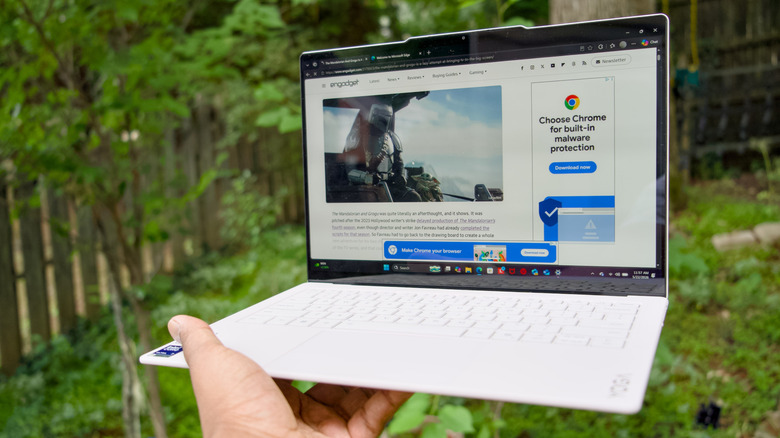
Even before I opened the Yoga Slim 7i, its light weight was noticeable. At first, I thought Lenovo sent me an empty box or a small tablet, not a premium 14-inch laptop. When I lifted the Yoga Slim out of its package, it still felt more like an iPad Pro than a notebook.
While Lenovo isn't the first company to deliver a premium laptop at that weight — I was also stunned the first time I held the ASUS ZenBook A14 — it's the first one I've encountered with an Intel chip. The Yoga Slim 7i is powered by Intel's Core Ultra 7 355, an eight-core chip meant for efficient-yet-powerful systems. That gives it a leg up over the A14, which uses a Snapdragon ARM chip that requires emulating older Windows apps and is also incapable of running some PC games.
The Yoga Slim 7i's magnesium alloy case also feels better than any Lenovo system I've tested before. It's smooth and warm to the touch, almost velvety, compared to cold aluminum cases on Apple's laptops. But despite feeling a bit soft, the case itself also feels very strong, with very little flex. The only hitch in the Yoga Slim 7i's design is a slight notch at the top of the screen, which houses its 5-megapixel camera and hardware for Windows Hello facial recognition. Personally, I think the notch gives the system a bit of character, and it also serves as a nice fingerhold when opening the case. But I also know plenty of consumers find any sort of notch to be an eyesore.
I don't think anyone will argue about the greatness of the Yoga Slim 7i Ultra's screen, though. It's a 14-inch POLED display — basically a version of OLED for lightweight devices — with a 2.8K resolution and up to 500 nits of SDR brightness and 1,100 nits of HDR. It also covers 100 percent of the SRGB and P3 color gamuts, making it accurate for photography and video production.
 Devindra Hardawar for Engadget
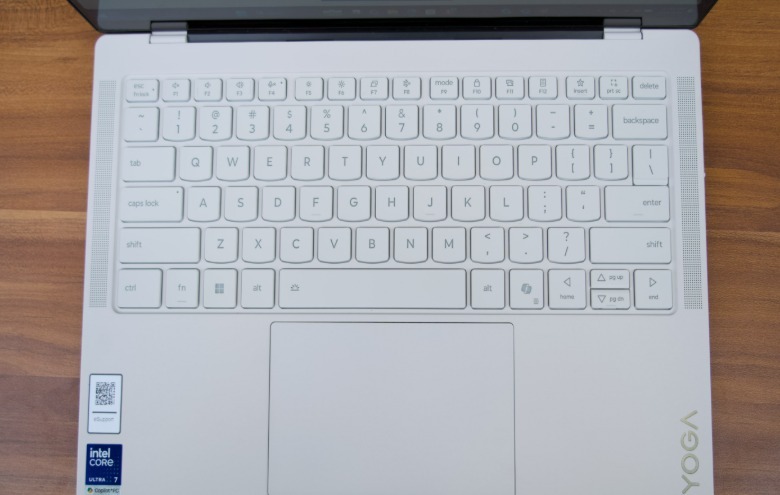
The more I used the Yoga Slim 7i Ultra, the more impressed I was by Lenovo's thoughtful design. Its keyboard is wide and spaciously laid out, with a healthy amount of key travel. I'm used to ultra-thin computers feeling a bit weak and flimsy with my heavy typing fingers, but the Yoga Slim 7i held up like a champ. It's the sort of keyboard that feels like it's inviting you to write thousands of words every time you sit down. Its large haptic touchpad feels similarly inviting, with none of the frustrating input hiccups I've noticed on some premium Windows laptops.
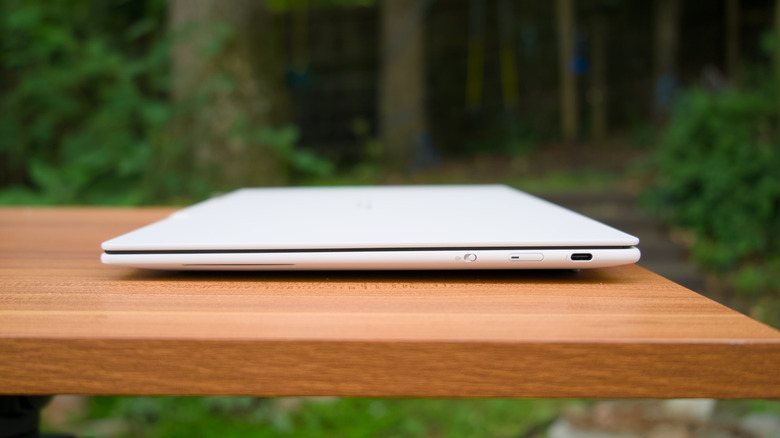
I wish Lenovo tried a bit harder to include some functional ports, though. The Yoga Slim 7i Ultra has three Thunderbolt 4 USB-C connections — two on the left, one on the right — but that's it. There's no USB Type A or HDMI like ASUS often manages to squeeze in. Hell, there isn't even a headphone jack! I realize there are certain design demands on super-slim laptops, but at the very least, give us a headphone jack.
I get it. Lenovo wants a nice and clean Apple-esque aesthetic. But even Apple learned that its MacBook Pros needed more useful ports. And even the cheaper Air models have headphone jacks. That's more helpful than the Yoga's hardware switch for disabling the camera, which takes up useful space near the ports.
In-use: A beautiful and capable thin laptop
There's just something delightful about using a laptop that weighs just 2.15 pounds. It feels like nothing when it's sitting on your lap, and it's easy to tote around all day without any issue. The Yoga Slim 7i Ultra isn't the most powerful laptop we've seen, but it's certainly one of the most pleasant. Almost every part of it sparks joy: That gorgeous OLED screen, which is perfect for watching movies; the keyboard that understands the assignment; the mere fact you don't have to worry about emulating older Windows apps. It feels empowering in the way a great gadget should.
It's also powerful enough to tackle most basic productivity work, so long as you don't need to render tons of video or play 3D games. The Yoga Slim 7i Ultra scored 8,845 points in the PCMark 10 benchmark, over 1,000 points more than the HP Omnibook Ultra and low end XPS 13 with the same Intel Core Ultra 7 chip. Its Geekbench 6 CPU score is also significantly higher than the ASUS ZenBook A14, a super-slim laptop I criticized for being woefully underpowered.
Unfortunately, this system doesn't have Intel's beefy Arc GPU, but its integrated graphics can handle basic games in a pinch. But by basic, I mean very basic. It handles simple 2D platformers and indie games just fine, and you can even play Fortnite (if you don't mind incredibly low-resolution models and textures). The Yoga Slim 7i Ultra scored 5,073 points in the 3DMark Wildlife Extreme benchmark, slightly below the MSI Prestige 14 Flip AI+.
One advantage of not having the fastest CPU and GPU around? Excellent battery life. In the PCMark 10 Modern Office battery benchmark, the Yoga Slim 7i lasted for 17 hours and 30 minutes. In real-world usage — which involved lots of web browsing, typing, photo editing and video chats — the system lasted around two full workdays before completely losing power.
Should you buy the Yoga Slim 7i Ultra?
I can't deny that this is a very nice laptop, especially if you cherish portability and screen quality over raw power. But it's also hard to stomach the Yoga Slim 7i's $2,000 starting price. It's currently $2,250 at Best Buy for our review configuration with 32GB of RAM and a 1TB hard drive. For that price, you could get both a MacBook Air and an iPad Air, or a 14-inch MacBook Pro.
Even in this RAM-constrained era, PCs still go on sale occasionally, and prices will hopefully eventually go down. If the Yoga Slim 7i scales down closer to $1,500, it would feel like a less extravagant purchase (especially given its weak graphics performance).
Wrap-up
The Yoga Slim 7i Ultra Aura Edition proves that Lenovo has come a long way over the last decade. I'd still be wary of the company's cheaper systems — a category better served by ASUS and Acer — but now it's clear the company can deliver something that feels right at home alongside other premium notebooks. It's just too bad the price puts it out of reach for most people who just need a light and fashionable laptop.